No War on
Venezuela!
RESOURCES
On January 3rd, 2026, The United States launched a military operation to remove Venezuelan President Nicolás Maduro from power. During the early-morning hours of January 3 forces struck targets in Caracas and captured Maduro and his wife, Cilia Flores, removing them from Venezuela and flying them to the United States. The raid injured hundreds and killed at least 56 people. Two days later on January 5th, both Maduro and Flores appeared in federal court in Manhattan for an initial hearing, where they pleaded not guilty to U.S. charges including drug and weapons offenses. On that same day in Venezuela, Delcy Rodríguez—who had been vice president—was sworn in as acting president by the National Assembly following Maduro’s removal. The current situation in Venezuela exemplifies the ongoing struggle between imperialist forces and a sovereign people committed to upholding the institutions and revolutionary project that they’ve spent decades building.
Below is an array of resources to help unpack the most recent events, the broader context, and the continued history of US aggression in the region.
What’s Happening Right Now?
Combatting Trump’s Narrative
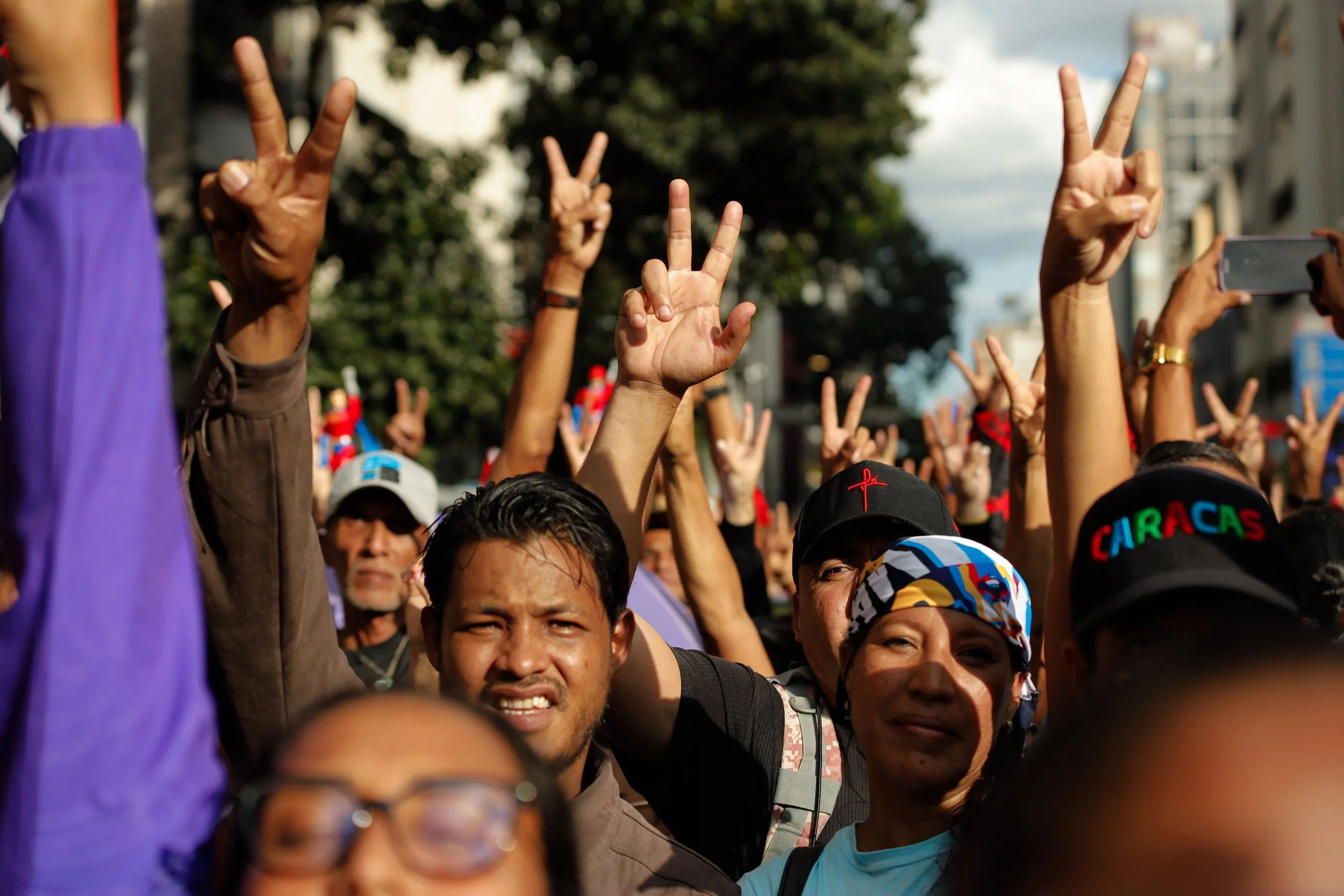
One of the most important things that we must know about current events is that the Trump administration is making every attempt to sway public opinion and obscure the facts in order to serve their own political agenda. In an article for People’s Dispatch, Manolo De Los Santos debunks the Trump administration’s lies and lays out the objective conditions of the US military intervention. In it, he explores the asymmetry of power between the U.S. and Venezuela, as well as the U.S. domestic opposition to military intervention. Despite the Trump administration’s attempts, it is clear the Venezuelans on the ground largely are opposed to this most recent attack on their country’s sovereignty. For more resources to study the current situation in Venezuela and to hear the reaction of the Venezuelan people on the ground check out the following:
“I Am the President of Venezuela”
In his appearance at the court, Maduro made it clear that he intended to remain the President of Venezuela, and highlighted his status as a prisoner of war. Speaking on the attack, the Trump administration claimed that they will be “running Venezuela.” Check out this episode of The Socialist Program where Brian Becker is in conversation with The Peoples Forum’s Layan Fuleihan about the events.
Ongoing Boat Strikes and Escalation
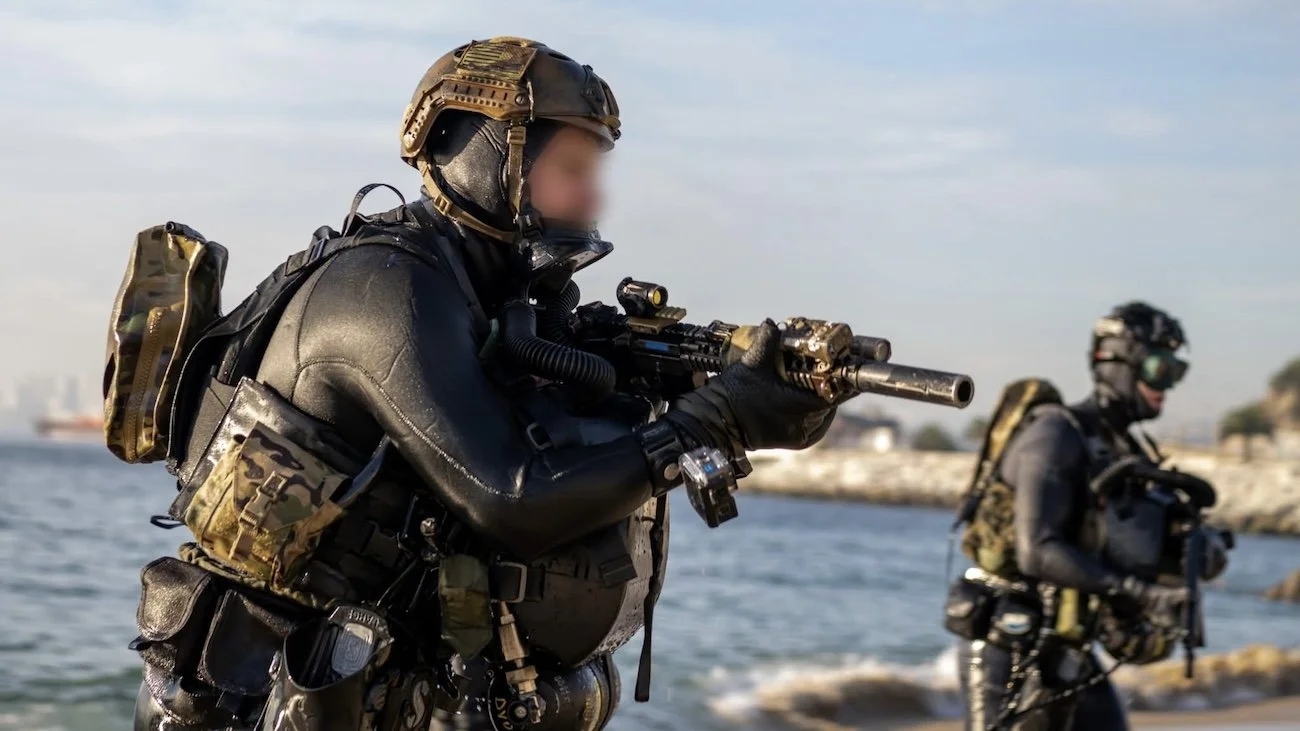
The U.S. military has been launching an offensive against Venezuela under the guise of the “War on Drugs.” Through ongoing US military air strikes targeting boats off the coast of Venezuela. The strikes are supposedly in retaliation to the Venezuelan government’s unsubstantiated connection to the Tren de Aragua gang. The strikes have killed dozens in the Caribbean.
In all, these most recent events have been part of an ongoing pattern of U.S. escalation and aggression in Latin America. For more resources to study the air strikes on Venezuelan boats and the U.S.’s pattern aggression towards Venezuela, check out the following:
Understanding the Broader Context
Why Venezuela?
Since the victory of Hugo Chavez and the revolution in 1999, the United States and its allies have launched various ploys in order to destabilize the country. In 2002, the U.S. supported a failed coup against Venezuela's democratically elected president, Hugo Chávez, with declassified CIA documents revealing prior knowledge of the plot. The people of Venezuela quickly defeated the U.S.-backed coup, but the event set the stage for ongoing U.S. efforts to destabilize Venezuela, as Chávez’s socialist policies and rejection of U.S. dominance in Latin America were seen as direct threats. Chávez’s outspoken critique of U.S. imperialism and support for revolutionary movements, such as those in Bolivia and Cuba, led the U.S. to isolate Venezuela and impose sanctions on its government officials.
In 2015, President Obama declared Venezuela a national security threat and imposed economic sanctions, including freezing assets, restricting oil exports, and limiting financial transactions, all aimed at weakening the already struggling economy due to a stark fall in oil prices. This marked the start of a broader U.S. hybrid war strategy, involving support for opposition movements like Juan Guaidó’s 2019 self-declaration and ongoing regime change efforts, such as the failed coup attempt in the 2024 elections.
Venezuela's vast natural resources, especially its oil and gold reserves, are of great strategic interest to the U.S.. Although resources were nationalized under the previous government, the profits went to rich and multinational corporations often with ties to the U.S. Chávez initiated a system to change this and make sure that the profits from these industries were redirected to social programs that benefited the Venezuelan people rather than foreign corporations.
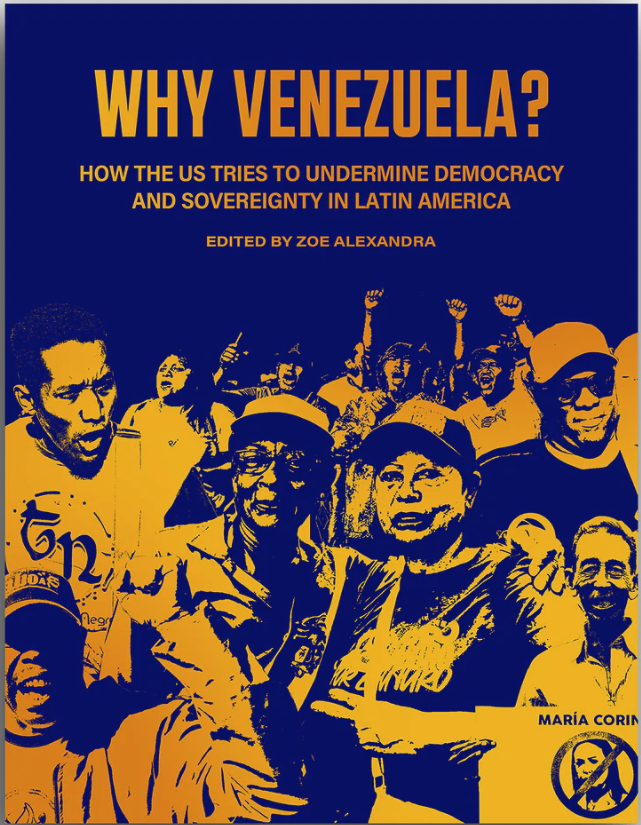
The Bolivarian Revolution, focused on sovereignty, anti-imperialism, and regional unity, has inspired leftist movements throughout Latin America, challenging long-standing U.S. domination in the region, evident from the Monroe Doctrine to today. For the U.S., Venezuela's example threatens not only its economic interests but also its political dominance in the region, as it has become a symbol of resistance to U.S. control and a model for democratic struggles against imperialism. For more resources to study the U.S.’s interventions in the democratic process in Venezuela, check out Why Venezuela? How the US Tries to Undermine Democracy and Sovereignty in Latin America.
Sanctions & Hybrid War
Hybrid war is a complex form of warfare that employs various tactics in covert ways, making it difficult to identify the aggressor. While it can include direct military intervention in some cases, more often it involves a range of non-traditional tactics, include economic sanctions, blockades, disinformation campaigns, bribery, engineered social unrest, and both "soft" and "hard" coups, designed to destabilize or undermine a target without resorting to large-scale warfare. In the case of Venezuela, the U.S. has used hybrid warfare tactics, including sanctions, media manipulation, and support for opposition groups, to undermine the Bolivarian Revolution and weaken the country’s sovereignty.
Even prior to the bombing of Caracas and the targeting of offshore vessels in Venezuelan waters, the U.S. had already been engaging in aggressive and violent behavior in the region in the form of sanctions. A report by the Center for Economic Policy and Research, Economic Sanctions as Collective Punishment: The Case of Venezuela, revealed that economic sanctions often have lethal consequences, with evidence showing they cause declines in income and life expectancy similar to armed conflicts, making them one of the deadliest tools used by Western powers.
Since 2019, the U.S. and its allies have imposed a devastating blockade on Venezuela, freezing over $8 billion in assets, including nearly $2 billion in gold at the Bank of England, and blocking $342 million in accounts from Venezuela’s Central Bank. This blockade, which targets key sectors of the economy and includes measures like banning transactions with state entities and seizing national assets, has deprived Venezuela of critical revenue and worsened its ongoing economic crisis.
According to the Lancet report, Venezuela's humanitarian crisis, resurgence of vector-borne diseases, and implications for spillover in the region, the severe economic crisis brought on in part by US sanctions has led to a public health crisis and the re-emergence of many vector-borne diseases like malaria. Even before the dropping of bombs, the U.S. sanctions on Venezuela have imposed severe human costs, resulting in widespread malnutrition, limited access to medicine and treatment, disease, and death, triggering an unprecedented migration wave of millions of Venezuelans.
What is The Monroe Doctrine?
This recent attack has shown itself to be a revival of The Monroe Doctrine. The Monroe Doctrine is a U.S. foreign policy principle announced in 1823 that declared the Western Hemisphere off-limits to European colonization or interference. While often framed as a defensive measure, it evolved into a justification for U.S. dominance over Latin America, asserting the region as a U.S. sphere of influence. The doctrine was used to legitimize political, economic, and military intervention in Latin American countries under the pretext of maintaining “stability” and protecting U.S. interests.
The recent “Trump Corollary” to the Monroe Doctrine explicitly reasserted U.S. control over the hemisphere and framed countries like Venezuela as threats, particularly due to their oil resources and alliances with China and other non-U.S. powers. Under this framework, sanctions, military posturing, and economic pressure against Venezuela are presented as defensive measures against “foreign influence,” but critics argue they reflect a long-standing imperial tradition rooted in the Monroe Doctrine rather than respect for Venezuelan sovereignty.
For more resources to study the Monroe Doctrine, it’s impact on Venezuela, it’s broader impact globally, and Trump’s newest assertions, check out the following:
“The Monroe Doctrine is a thing of the past; it’s the doctrine of the imperialists. It’s time to bury it forever.”
—Hugo Chavez
Upholding Venezuelan Sovereignty
Even as the U.S. continues its physical, media, and legislative assault on Venezuela, global solidarity remains strong, as millions across the world support Venezuela’s self-determination and resist the Monroe Doctrine-like imperialist policies that seek to subjugate the country.
The Venezuelan people continue to demonstrate a steadfast commitment to defending against the U.S.’s attempts at intervention. Venezuela’s fight afainst this imposed regime change exemplifies the ongoing belief in the Bolivarian revolution and project.
For more grounding on this topic, check out this class from last year taught by Carlos Ron of the Simon Bolivar Institute for Peace and Solidarity Among Peoples.
Hands off Maduro! Hands off Venezuela!
TO STUDY MORE about VENEZUELA AND THE BOLIVARIAN REVOLUTION, Check out some of these resources
-
The Revolution Will Not Be Televised, by Kim Bartley and Donnacha Ó Briain (link)
-
Why Venezuela: How the US Tries to Undermine Democracy and Sovereignty in Latin America (link)
Understanding the Venezuelan Revolution (link)
Commune or Nothing: Venezuela’s Communal Movement and its Socialist Project (link)
Chavez and the Irreversibility of the Bolivarian Revolution (link)
Our Own Path to Socialism: Selected Speeches of Hugo Chavez (link)
-
-