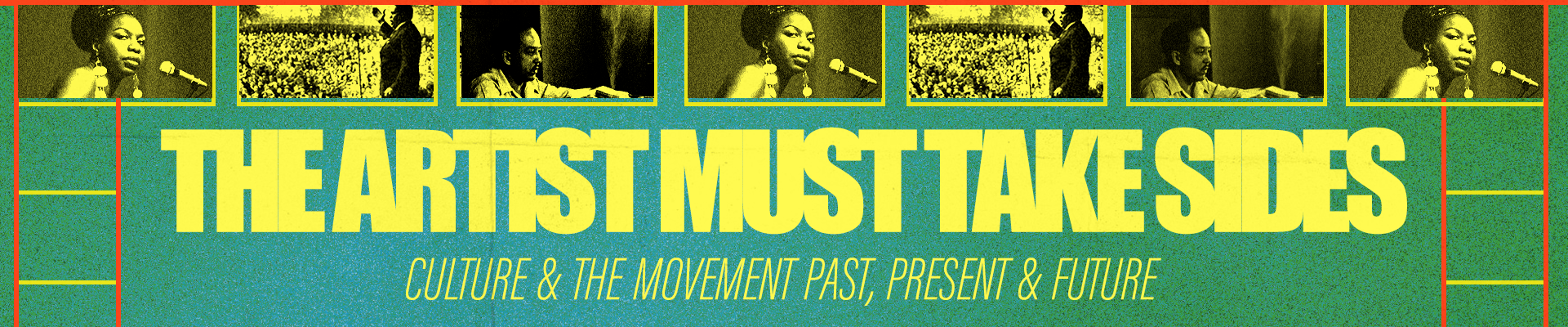
“The artist must take sides. He must elect to fight for freedom or for slavery. I have made my choice. I had no alternative.”
— Paul Robeson
Course Description
The course is completely free, with donations accepted to help continue our programming. Please donate to help sustain the course programming!In times of war and crisis, when people are rising up, when people are taking a stand, when the stakes could not be higher– what is the responsibility of the artist?
History points us to the answer. Culture is the heartbeat of our movements. It brings people into collective action, sharpens our sense of our own power, and makes a better future feel possible. But the ruling elites also use culture to flood our screens with art that makes the current crisis feel natural, inevitable, and permanent. Artists on the side of freedom have to fight back. Nina Simone, Langston Hughes, June Jordan, Elizabeth Catlett, and Paul Robeson all took a side. The muralists of the Chicano Movement took a side. Hip-hop artists and those speaking out on stages, screens, studio walls, and the streets today take a side. Now, we as artists have to consider what that looks like in today’s context.
In this course presented by Artists Against Apartheid & The People’s Forum, we will study the role of the artist in the movement. We will discuss the responsibility of artists to struggle against the system that exploits, alienates, and pacifies and towards building a culture that inspires, drives, and sustains our collective struggle for liberation. Art alone cannot make a revolution, but it can transform the people who will.
More About the Course: You can take this course from anywhere in the world — join live in-person in NYC at The People’s Forum and online via zoom, or access recordings and readings on your own time. There will also be opportunities to connect with people participating in your regional area to watch classes, discuss and build connections together. Register now and we will follow up with details about local participation.
Drawing from the tradition of the Black Arts Movement, the John Reed Clubs, and other radical artist organizing, part of this course will be Artist Salons — gatherings to exchange ideas, and discuss how to bring the classroom lessons into our artistic practices and organizing. Salons will take place twice over the 6 week course, with some opportunities for those outside NYC to plug into one in their area.
Session
Schedule
Tuesday April 21 to May 26,
6:30 – 8:30 PM ET.
In-person at 320 W 37th St. NYC + Online via zoom
-
This class lays the foundation for understanding art and culture within the context of society and the economy. It will examine how culture functions as a site of struggle — shaping consciousness, reinforcing or subverting dominant power, and offering possibilities for resistance. Drawing from thinkers like W.E.B. Du Bois and from historical and recent traditions of working-class cultural production,we will explore how art and culture is not an isolated or purely individual pursuit, but rather it is a collective practice tied to material conditions. Together, we will build a shared language to understand culture not as separate from politics, but as one of its most contested battlegrounds. The question at the center: in whose interest, and for what purpose, do we produce art?
-
This class traces the history of art as a force within movements for liberation in the United States, from slavery to the present. The course follows a continuous thread through key traditions of Black cultural expression—from the spirituals created under slavery, through abolitionist-era print and performance culture, the music and visual language of the Civil Rights Movement, the emergence of hip-hop as a global political and cultural force, and contemporary muralism and visual culture continue these traditions today. Rather than treating these moments as isolated genres or periods, the class emphasizes continuity: how each generation inherits, transforms, and reimagines cultural tools under shifting conditions of struggle
-
-
This class examines how the US ruling class has produced, policed, and controlled art and culture to maintain power. We will look at State Department–sponsored cultural diplomacy, the persecution of artists like Paul Robeson, the Hollywood blacklist, McCarthyism, and the Pentagon’s ongoing relationship with the film industry, tracing how cultural production has been shaped, constrained, and disciplined in the service of empire. Along the way, we will raise key questions: What does it mean for an artist to choose a side? What are the consequences of that choice? And how does the US ruling class respond when culture steps outside the limits set for it, and how have artists fought back? We will ground these questions in both historical and contemporary examples, examining culture not only as a tool of repression but also as evidence of the courage and boldness of artists who have dared to resist.
-
This class will look at the rich history of artists organizing collectively to fight back — from the John Reed Clubs, which grew and spread across the country as hubs of radical creative life, to the Artists Union, the American Artists Congress Against War and Fascism, and Artists United Against Apartheid — tracing how cultural workers have built power not as isolated individuals, but as a movement. Drawing on these models, students will turn to the question of what we need today: the organizations, collectives, and collective strength required to meet this political moment and forge a culture of resistance equal to the struggle ahead.
-